Noble Hill and the Wines of Kristopher Tillery
Noble Hill and the Wines of Kristopher Tillery
Noble Hill and the Wines of Kristopher Tillery
Noble Hill and the Wines of Kristopher Tillery
Food & Wine
Food & Wine
A self-taught winemaker on the Paarl side of the Simonsberg, making organic wines that argue quietly against everything fashionable.
A self-taught winemaker on the Paarl side of the Simonsberg, making organic wines that argue quietly against everything fashionable.
A self-taught winemaker on the Paarl side of the Simonsberg, making organic wines that argue quietly against everything fashionable.
Author
Author
Author
Tom Clark
Tom Clark
Tom Clark
Photography
Photography
Photography
Micha Weinberger
Micha Weinberger
Micha Weinberger
The Simonskop Chenin Blanc at Noble Hill comes from dryland vines planted in 1987, high on the Simonsberg in decomposed granite soil. It is one of several wines in Kristopher Tillery's range, and the 2023 vintage earned five stars from Platter's, the country's most trusted wine guide. The 2025 was picked by hand on the first of February. It made just 1,380 bottles.
Anyone who knows wine estates will recognise these as small numbers, deliberately so. They are the numbers of a man making the wine he believes in, not the wine that sells easiest.
Kristopher Tillery is the self-taught winemaker and proprietor at Noble Hill. He studied economics and sustainable development at Harvard, then worked as a strategy consultant before his family bought the farm in 2006. I have tasted through his range more times than I can count, and the thing that holds, every time, is that the wine still tastes like the mountain it grew on, cared for rather than corrected.


"They are the numbers of a man making the wine he believes in."
"They are the numbers of a man making the wine he believes in."
The wines were not always this quiet. When Kristopher took over the cellar, Noble Hill was making wine in the fashion of the time: ripe, heavily extracted, oaked hard. He didn't care for it. He had no formal training, only discipline and a real passion for the vineyard, and that combination, he has said, left him free to trust his own instincts about what he liked in a glass.
The corrections came slowly, and they were real. Extraction on the reds eased off. Alcohol came down. Ferments were left to start on their own, with wild yeast rather than a cultured strain. New oak gave way, first to older barrels, then increasingly to concrete and clay amphorae. The reds are now bottled without fining or filtration.
The farm sits on the Paarl side of the Simonsberg, in the less fashionable Wine of Origin Simonsberg-Paarl, over the mountain from Stellenbosch's more famous slopes. Right next door sits Babylonstoren, grown over the years into something closer to an empire than a farm, hotel and spa and shop folded in around the vines. Noble Hill has taken the opposite path. Thirty hectares under vine, family-run, and the ambition here has never been to grow the place, only to leave it as it was. The soil is decomposed granite, and Kristopher believes you can taste it in the glass. The vineyards are certified organic through Ecocert to both EU and US standards, and Noble Hill was a founding member of Organic Wines South Africa.
It's the whites I'd point you toward first. The Simonskop Chenin Blanc, aged in old barrels and clay, carries honeyed apple and apricot over a chalky, mineral finish that gives the granite away. The Brut Nature Blanc de Blancs goes into bottle with no dosage added, a decision most estates are too nervous to make. The reds follow the same instinct. The Cabernet Sauvignon leans savoury rather than jammy, cassis cut with a herbal, minty edge that marks it as Simonsberg fruit, while Field Atlas, a co-fermented field blend led by Syrah and Mourvèdre, sits closer to black pepper and olive than to red fruit.
Most people arrive in the Winelands with one day and a list of names handed to them by a hotel concierge. Noble Hill rarely makes that list. The estate is small, it doesn't chase volume, and the tasting room sees a fraction of the guests that pass through the larger properties before noon. That's the case for going.
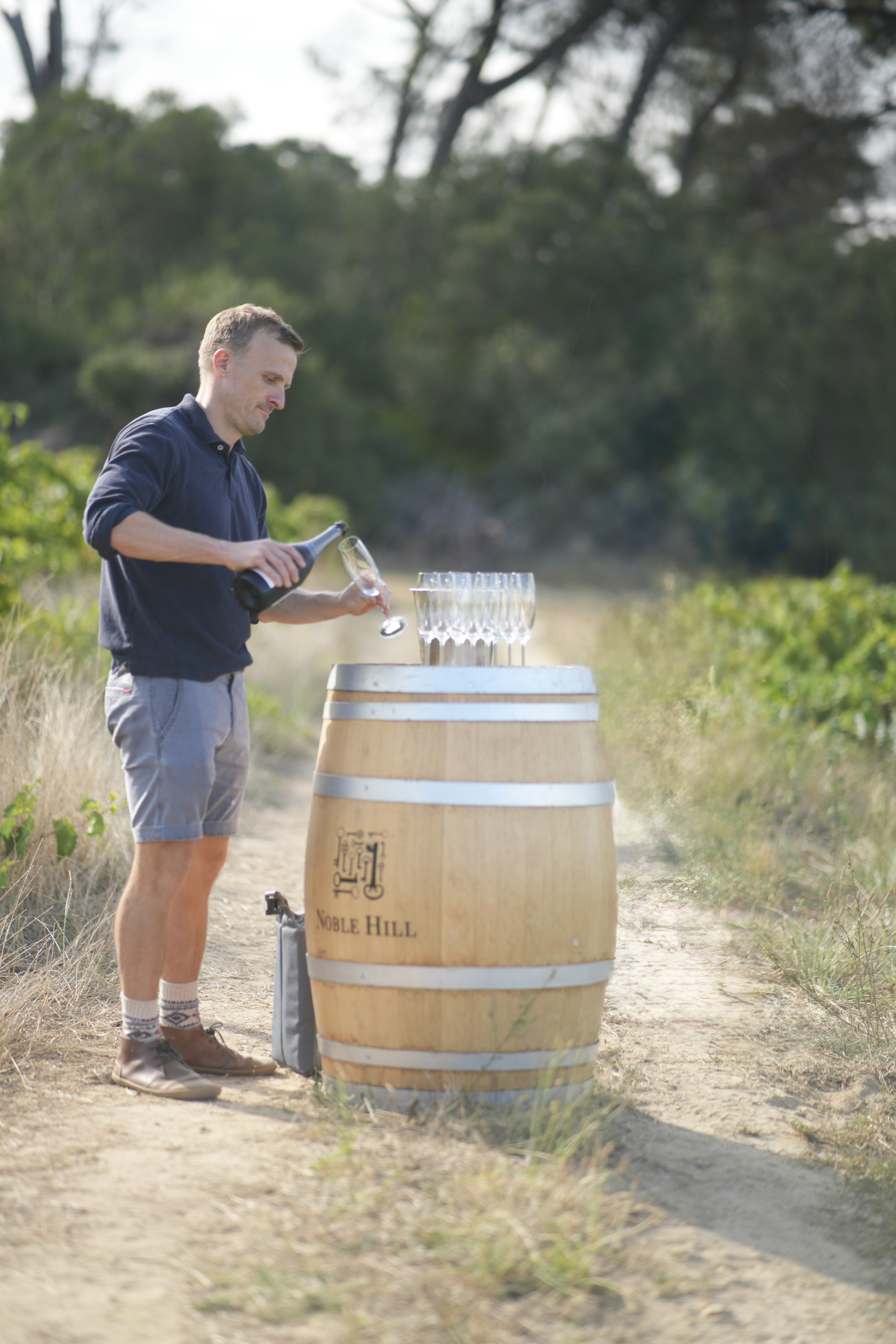
Our Winelands Curated Tour moves through art, architecture and wine across Franschhoek, Stellenbosch and Simonsberg-Paarl in a single day, and we save Noble Hill for last. We call it a vineyard safari: walking the vines themselves as the sun drops, tasting wine with the whole valley spread out below. If wine matters more to you than buildings, we'll build the day around that instead. To plan yours, enquire.
Tom Clark is the co-founder of Design Safaris, a Cape Town-based company offering private curated tours focused on art, architecture, design, and cuisine.
The wines were not always this quiet. When Kristopher took over the cellar, Noble Hill was making wine in the fashion of the time: ripe, heavily extracted, oaked hard. He didn't care for it. He had no formal training, only discipline and a real passion for the vineyard, and that combination, he has said, left him free to trust his own instincts about what he liked in a glass.
The corrections came slowly, and they were real. Extraction on the reds eased off. Alcohol came down. Ferments were left to start on their own, with wild yeast rather than a cultured strain. New oak gave way, first to older barrels, then increasingly to concrete and clay amphorae. The reds are now bottled without fining or filtration.
The farm sits on the Paarl side of the Simonsberg, in the less fashionable Wine of Origin Simonsberg-Paarl, over the mountain from Stellenbosch's more famous slopes. Right next door sits Babylonstoren, grown over the years into something closer to an empire than a farm, hotel and spa and shop folded in around the vines. Noble Hill has taken the opposite path. Thirty hectares under vine, family-run, and the ambition here has never been to grow the place, only to leave it as it was. The soil is decomposed granite, and Kristopher believes you can taste it in the glass. The vineyards are certified organic through Ecocert to both EU and US standards, and Noble Hill was a founding member of Organic Wines South Africa.
It's the whites I'd point you toward first. The Simonskop Chenin Blanc, aged in old barrels and clay, carries honeyed apple and apricot over a chalky, mineral finish that gives the granite away. The Brut Nature Blanc de Blancs goes into bottle with no dosage added, a decision most estates are too nervous to make. The reds follow the same instinct. The Cabernet Sauvignon leans savoury rather than jammy, cassis cut with a herbal, minty edge that marks it as Simonsberg fruit, while Field Atlas, a co-fermented field blend led by Syrah and Mourvèdre, sits closer to black pepper and olive than to red fruit.

Most people arrive in the Winelands with one day and a list of names handed to them by a hotel concierge. Noble Hill rarely makes that list. The estate is small, it doesn't chase volume, and the tasting room sees a fraction of the guests that pass through the larger properties before noon. That's the case for going.
Our Winelands Curated Tour moves through art, architecture and wine across Franschhoek, Stellenbosch and Simonsberg-Paarl in a single day, and we save Noble Hill for last. We call it a vineyard safari: walking the vines themselves as the sun drops, tasting wine with the whole valley spread out below. If wine matters more to you than buildings, we'll build the day around that instead. To plan yours, enquire.
Tom Clark is the co-founder of Design Safaris, a Cape Town-based company offering private curated tours focused on art, architecture, design, and cuisine.


Continue Reading
Continue Reading
Continue Reading


Are you an aesthetic explorer?
Get our newsletter and explore the world with us
©aēsplore . 2026
we the aesthetic explorers
Are you an aesthetic explorer?
Get our newsletter and explore the world with us
©aēsplore . 2026
we the aesthetic explorers
Are you an aesthetic explorer?
Get our newsletter and explore the world with us